

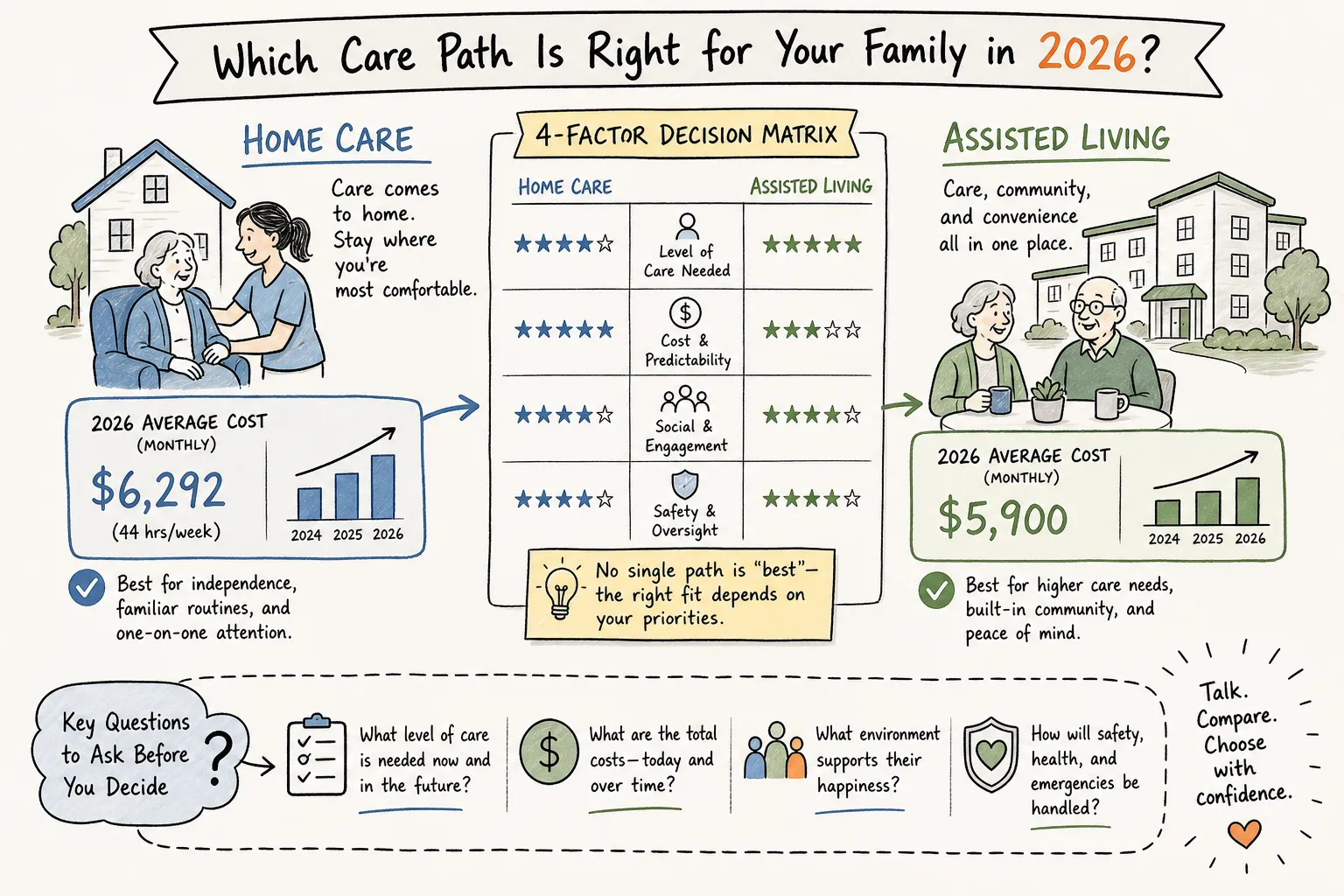
You walk into your parent’s living room and something feels off. There’s a stack of unopened mail on the kitchen counter, a pill organizer with yesterday’s dose still in it, and your parent is telling you everything is fine. It isn’t fine. And in that moment, a question surfaces that you’re not sure how to answer: do they need someone coming to the house, or is it time to think about moving to a community where care is built into the environment? That question, home care vs. assisted living, is one of the most consequential decisions a family will make, and getting it right depends on more than instinct.
At Avodah Home Care, we’ve guided South Carolina families through this exact crossroads for over a decade. The right answer isn’t the same for every family. But there are clear factors that point toward one path over the other, and understanding those factors is what separates a confident decision from one driven by guilt or urgency. This article walks through those factors side by side: what each option actually covers, what it costs in 2026, a four-factor decision framework, clinical warning signs, how insurance works, and the questions worth asking before you commit.
What Each Care Option Actually Covers
The most common mistake families make when weighing home care vs. assisted living is assuming both options provide similar services in different settings. They don’t. Assisted living is a residential model. The monthly fee typically bundles housing, meals, housekeeping, laundry, transportation, and a staff-supervised environment with 24-hour coverage. Personal care assistance with bathing, dressing, grooming, and medication management is either included or added at a tiered rate. Social programming and communal activities are built into the daily routine.
In-home care delivers personal care, companionship, medication reminders, light housekeeping, transportation to appointments, and skilled nursing support directly in the senior’s own home. The care comes to them. The residence, community dining, and built-in social structure are not part of the arrangement. Nor does it bring the disruption of uprooting a person from a home they may have lived in for decades.
Assisted living packages care and environment together. In-home care isolates care as a standalone service. For a senior whose home is manageable and who still benefits from familiar surroundings, the bundled model may be more than they need. For a senior who needs continuous supervision, in-home care alone may not be sufficient without round-the-clock staffing, which changes the cost calculus significantly. That difference drives every other factor in this comparison.
Home Care vs. Assisted Living: Cost Comparison for 2026
Cost is rarely the only factor, but it’s almost always the first question families ask. According to A Place for Mom’s 2026 long-term care report, the U.S. median assisted living cost is approximately $5,419 per month, with some facility estimates ranging between $6,200 and $6,386 depending on location and care level. In South Carolina, costs tend to run below the national median, with averages reported between $4,345 and $5,350 per month. That covers housing, meals, and bundled services, but it’s a fixed cost regardless of whether your parent needs light assistance or intensive daily care.
The national median home care rate sits at $34 per hour in 2026. At 20 hours per week, that translates to roughly $2,944 per month, nearly half the cost of assisted living. The trade-off is real: if a senior needs 40 or more hours of care per week or around-the-clock support, home care costs can approach or exceed assisted living costs. The break-even point exists, and families need to calculate it based on their parent’s actual daily care needs, not a generic estimate.
A senior who is mostly independent but needs 10 to 15 hours of help per week sits clearly in home-based care territory from a cost perspective. A senior requiring full-day coverage or specialized memory care is a different calculation entirely, and that’s where the next four factors become more important than the hourly rate.
Four Factors That Point Toward the Right Choice
Cost matters, but it doesn’t make the decision on its own. These four factors cut closer to the reality of what your parent needs right now and what they’re likely to need over the next 12 to 24 months.
Mobility and daily function. How well can your parent manage activities of daily living (ADLs) such as bathing, dressing, transferring, and toileting? The Katz Index of Independence in Activities of Daily Living is a widely used clinical tool that measures independence across these core functions. A senior who needs help with one or two ADLs can typically be supported safely at home with a structured care plan. Multiple ADL deficits often signal a need for more continuous oversight.
Cognitive health and safety at home. Mild memory changes and early-stage cognitive decline don’t automatically rule out home-based care. What matters is whether those cognitive changes create safety risks: wandering, medication errors, leaving the stove on, or getting disoriented in familiar spaces. Structured in-home care with dementia-trained caregivers can manage early to moderate cognitive decline effectively in the right home environment.
Medical complexity and care intensity. Seniors managing multiple chronic conditions, recovering from a hospitalization, or receiving wound care can often be supported at home through skilled nursing visits. When medical needs require around-the-clock monitoring or clinical intervention multiple times per day, the care model has to match the complexity. This is where an honest conversation with a nurse or care manager is worth more than a checklist.
Family involvement and proximity. How close is family, and how available are they to serve as a second layer of oversight? Families who live nearby and can supplement professional care regularly can often sustain a home-based model longer. Families who are far away or stretched thin may find that a residential setting provides a passive safety net that home care alone can’t replicate.
Warning Signs That In-Home Care May Not Be Enough
The four-factor framework helps structure the decision, but there are also concrete behavioral and clinical signals that indicate a senior’s needs have outpaced what home-based care can safely address on its own. Recurrent falls or unexplained bruises, repeated medication mistakes such as missed doses or double dosing, unpaid bills, significant weight loss, and declining personal hygiene are all indicators that daily oversight is no longer optional. Clinicians often use the Lawton Instrumental Activities of Daily Living (IADL) Scale alongside ADL assessments to measure how well a senior manages tasks like cooking, finances, and medication organization.
Wandering, a senior repeatedly leaving home unsafely or becoming disoriented in familiar spaces, is one of the most serious dementia-related safety concerns. When a senior requires continuous supervision to prevent harm, the level of vigilance needed may exceed what intermittent home visits can provide. This doesn’t automatically point to a facility. Dementia-specialized in-home care with a structured daily routine can manage moderate stages effectively. But families need to assess this honestly with a clinical professional rather than defaulting to an optimistic gut check.
How Medicare, Medicaid, and VA Benefits Factor In
Families often assume one of these programs will cover most of the cost. Here’s what each program actually does and doesn’t cover. Medicare does not cover assisted living room and board or custodial personal care. It may cover short-term, medically necessary skilled nursing or home health services following a qualifying hospitalization, but ongoing help with bathing, dressing, or companionship falls outside Medicare’s scope. Medicaid coverage for assisted living varies by state. In South Carolina, the Community Long-Term Care (CLTC) waiver program, also known as Community Choices, can help eligible seniors remain at home by funding personal care, companion care, respite care, and home accessibility modifications. The waiver covers care services, not room and board, making it particularly relevant for seniors choosing to age in place. Private long-term care insurance, when a policy exists, is often the most direct path to covering either option.
Veterans and their surviving spouses may qualify for VA Aid and Attendance benefits or VA Homemaker and Home Health Aide Care, which covers personal care assistance, bathing and dressing help, meal preparation, and respite for family caregivers. Avodah Home Care is an approved provider within the VA Community Care Network, which means eligible veterans in South Carolina can access professional in-home care services through their VA benefits without setting up a separate private-pay arrangement. For veteran families, this is a meaningful financial and logistical advantage worth confirming before making any long-term care decision.
How to Decide: Home Care vs. Assisted Living, Questions to Ask First
Knowing what to ask is what separates families who land in the right care arrangement from those who realize six months later that something important wasn’t disclosed upfront.
When touring an assisted living community, visit during mealtimes or an activity period so you can observe staff interaction with residents rather than just hear it described. Ask specifically about staff-to-resident ratios, caregiver turnover, how care plans are updated as needs change, what triggers a fee increase, and whether a nurse is on duty around the clock. Request the most recent state inspection report. This is public information and often reveals more than a walk-through alone.
When interviewing a home care agency, ask how caregivers are matched to clients and what happens when your assigned caregiver calls out sick. Ask whether caregivers are trained for the specific conditions your parent has, such as dementia or post-surgical recovery. Request clarity on how the care plan is created, who oversees it, and how family members are kept informed. Ask about after-hours emergency protocols, minimum visit lengths, and whether you can meet the caregiver before the first visit.
At Avodah Home Care, the care plan isn’t built by an intake coordinator filling out a form. A nurse-led case management team assesses your parent’s medical history, functional needs, and home environment before a caregiver is ever scheduled. Families receive regular courtesy check-ins, and the care plan is updated as needs evolve. For families genuinely undecided between these two options, this level of clinical oversight often makes aging in place both safer and more sustainable than they initially assumed.
Making the Call with Clarity, Not Guilt
There is no universal right answer in the home care vs. assisted living decision. What matters is making the call based on your parent’s actual functional and medical needs, your family’s realistic capacity to stay involved, and what each option genuinely delivers at the price you’re paying. The decision framework in this article is a starting point, not a substitute for an honest clinical assessment.
If your family is leaning toward aging in place and wants a professional evaluation of what a real care plan would look like, reach out to Avodah Home Care. We serve families across South Carolina, including Columbia, Lexington, Florence, and Greenville, with nurse-led, customized in-home care designed to make staying home genuinely safe and dignified. Call us or request a free consultation online to take the next step with someone who knows how to guide you through it.

- Senior Care in Columbia SC: Options, Costs & How to Choose - August 28, 2026
- Home Care vs. Assisted Living: What Families Must Know - August 28, 2026
- Dementia Care at Home: A Complete Guide for Families - August 18, 2026