

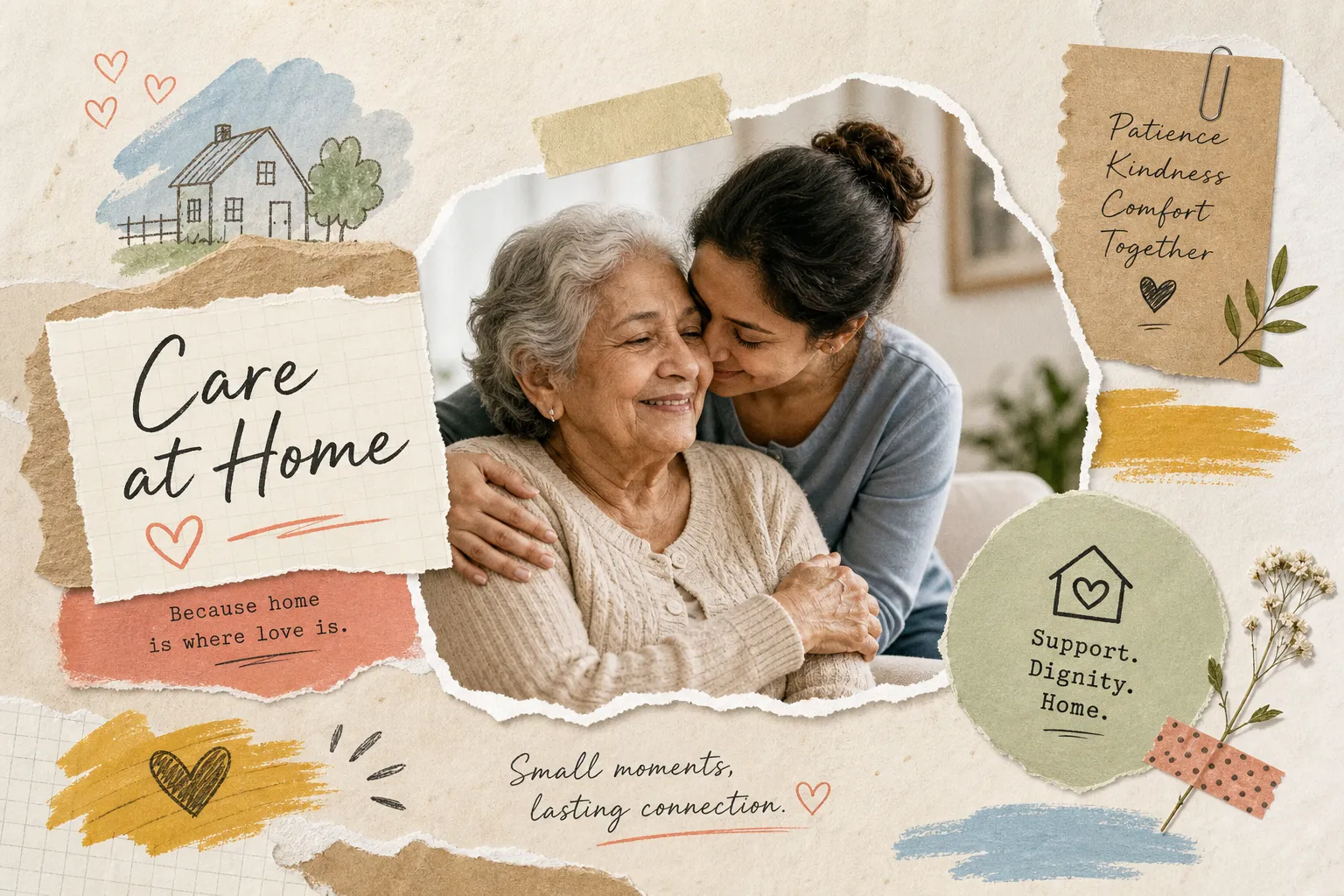
A dementia diagnosis changes everything in a single conversation, and figuring out dementia care at home is often the first challenge families face. One moment you’re a son, a daughter, a spouse. The next, you’re responsible for someone’s safety, daily care, and an illness you didn’t choose and probably don’t yet understand. Most families walk out of that doctor’s office without a clear plan, just love and good intentions, and quickly discover that love alone doesn’t prevent a fall at 2 a.m. or a stove left on for hours.
After years of walking alongside families through every stage of this journey, our team at Avodah Home Care knows what actually makes dementia care at home work, and what quietly puts loved ones at risk. This guide is the practical playbook we wish every family had from day one. By the time you finish reading, you’ll know how to match care to your loved one’s current stage, make your home safer, understand what you’ll realistically pay, ask the right questions when hiring a caregiver, and recognize the signs that the current plan needs to change.
What dementia actually demands from a home caregiver
Most families start out thinking dementia care is about helping with tasks: cooking, reminders, maybe some driving. What they don’t see coming is how completely the job transforms as the disease progresses. Dementia care at home isn’t a stable role; it’s a moving target that demands different skills, more hours, and deeper clinical knowledge at every stage.
How each stage of dementia shifts the caregiver’s role
In the mild stage, the priority is supporting independence while quietly adding safety layers and watching for behavioral changes. The person can often still participate in their own care, but they need a caregiver who notices when something shifts. In the moderate stage, the job expands significantly: managing confusion, behavioral episodes, wandering risk, and increasing physical assistance with daily activities. This is where caregiving becomes genuinely demanding and where untrained caregivers frequently struggle. By the advanced stage, care requires full-time supervision, hands-on personal care, and a comfort-focused approach that prioritizes dignity and safety above all else.
Why standard home care often isn’t enough for dementia
General home care experience doesn’t automatically translate to competent memory care at home. Dementia-specific behavioral knowledge is a separate skill set, knowing how to redirect without triggering agitation, how to read nonverbal distress signals, and how to manage sundowning are not standard caregiving competencies. Families need more than someone who completes a task list; they need someone who understands the disease behind the behaviors.
Dementia care at home: safety modifications for every stage
The home environment that was safe a year ago may not be safe today. The Alzheimer’s Association recommends a structured room-by-room safety review at diagnosis and again as the disease progresses. A trained assessor or clinician can catch hazards that families who live with the situation every day often stop seeing.
Safety essentials for mild dementia: simplifying and fall-proofing
Start with the basics that matter most for fall prevention and fire safety. Remove loose rugs, clutter, and anything that creates a tripping hazard. Improve lighting in hallways, stairs, and bathrooms. Install grab bars and handrails in bathrooms and on both sides of stairs. Set the water heater below 120°F to prevent scalding burns, a threshold recommended by the Consumer Product Safety Commission, add automatic shut-off appliances, and make sure smoke and carbon monoxide detectors are installed throughout the home and tested regularly.
Moderate to advanced dementia: locking hazards and preventing wandering
As dementia progresses, the risk profile shifts from falls to hazardous access and wandering. Lock away medications, cleaning supplies, sharp objects, and alcohol. Install stove shut-off devices or disable gas stoves if kitchen safety has become a recurring concern. Add door alarms and motion sensors to catch movement toward exits. For advanced dementia, wandering prevention becomes the central safety challenge: secured outdoor gates, higher or hidden door locks, bed rails, and stair lifts all become relevant depending on your loved one’s mobility and behavior. These modifications are not overreactions; combined with appropriate care, they can meaningfully reduce certain risks and help support staying at home longer.
Building daily routines that reduce agitation and confusion
Routine is one of the most underused tools in dementia caregiving, and the basic framework costs nothing to implement. A predictable structure reduces the cognitive demand placed on someone whose working memory is impaired. When the sequence of a day is consistent, the person with dementia doesn’t have to generate responses to constant novelty, and that reduction in demand can directly lower agitation, resistance, and behavioral episodes.
Why structure works: what research tells us about routine and dementia behavior
The Alzheimer’s Association recognizes structured, pleasant daily activities as an effective approach to reducing agitation and improving mood. Clinical literature supports activity-based interventions, particularly those tailored to the individual’s lifelong preferences, as a way to lower agitation while they are being provided. The key word is “individualized”: a generic schedule is far less effective than one anchored in what actually matters to your loved one. For sundowning specifically, the most consistent clinical guidance points to keeping the late afternoon calm, stable, and low-stimulation rather than overhauling the entire day.
Communication techniques that calm rather than confuse
Speak in short, direct sentences and make one request at a time. Avoid corrections when your loved one says something that isn’t accurate; arguing about reality creates distress without improving understanding. Instead, validate the feeling underneath the confusion and redirect with a familiar activity: a favorite song, a simple task, a walk outside. Lifelong preferences, music, food, hobbies, serve as powerful behavioral anchors throughout the day. These are not tricks; they are well-established clinical tools that can make a real difference.
Understanding in-home dementia care costs and how to pay for them
Cost is usually the point where families either find a path forward or give up on professional care entirely. The numbers are real and significant, and the financial weight of that conversation is felt by nearly every family we work with. That said, there are more funding options than most families realize.
What families realistically pay for dementia caregiving at home in 2026
The national median for non-medical in-home care runs approximately $34 to $35 per hour in 2026. At a 40-hour-per-week schedule, that translates to roughly $5,440 to $5,600 per month. Around-the-clock care, which many families in the moderate to advanced stages eventually need, runs approximately $24,733 to $25,500 per month nationally. South Carolina costs may vary slightly from these national averages, but they are a reliable planning baseline.
Federal and state programs that help cover the cost
Families have more options than they often know about. The most important funding paths to explore include:
- Medicaid Home and Community-Based Services (HCBS) waivers, which can cover personal care, respite, and other in-home supports for eligible individuals in most states, including South Carolina.
- The National Family Caregiver Support Program (NFCSP), which funds respite, training, counseling, and information through local aging agencies.
- VA Aid and Attendance and Veterans Directed HCBS for eligible veterans. Aid and Attendance provides a monthly cash payment (approximately $2,424 for a veteran alone in 2026) that can be applied directly to in-home care costs, including custodial care for dementia.
- The Medicare GUIDE model, which launched in 2024 and provides care navigation, 24/7 support access, caregiver training, and up to $2,500 annually in respite services for original Medicare beneficiaries with dementia who live in the community and are not enrolled in hospice or Medicare Advantage.
- Long-term care insurance, if the policy includes home-care benefits, should be reviewed carefully for applicable daily benefit limits and elimination periods.
Hiring for dementia care at home: what families need to know
Hiring the wrong caregiver for a person with dementia doesn’t just mean poor care; it means behavioral escalation, safety incidents, and family crises that could have been avoided. Home care for Alzheimer’s and other dementias requires a higher hiring standard, and knowing the right questions to ask is the difference between a good placement and a dangerous one.
Questions every family should ask before signing a home care agreement
Ask specifically about dementia training: what program it came from and whether it is verified. The strongest credentials in 2026 come from recognized organizations: the Alzheimer’s Association’s essentiALZ® certification, the Alzheimer’s Foundation of America’s Certified Dementia Care Provider (CDCP) program, and the National Council of Certified Dementia Practitioners’ Certified Dementia Practitioner® (CDP®) credential. Then ask which specific behaviors the caregiver is trained to handle. Sundowning, wandering, resistance to care, and agitation are the non-negotiables. Ask who provides backup when the regular caregiver is unavailable and how transitions between caregivers are managed. Find out who to call after hours if something goes wrong.
Why caregiver continuity and nurse oversight change the outcome
Consistency in caregiving is not a preference; it is a clinical factor in dementia care at home. A familiar face, a familiar routine, and a familiar presence reduce agitation and build trust for someone who can no longer reliably form new memories. At Avodah Home Care, caregiver continuity is a standard practice, not an afterthought. Our nurse case management team provides an additional layer of clinical oversight that goes well beyond scheduling, conducting regular check-ins and assessments designed to catch changes before they become emergencies. All caregivers are Avodah employees with verified backgrounds, bonding, insurance, and dementia-specific training. That combination of clinical oversight and caregiver quality is what separates a genuinely safe care arrangement from one that looks fine on paper.
When home care is no longer enough: signs families often miss
Recognizing that the current care plan has stopped working is not a failure. It is an act of advocacy for your loved one. The families who struggle most with this decision are often the ones who have been watching the decline so gradually that each step seems manageable, until they step back and see the full picture.
Safety red flags that signal it’s time to reassess the care plan
Repeated wandering, unexplained falls, or kitchen incidents that home modifications haven’t resolved are serious signals. Missed or doubled medications, significant weight loss, or worsening hygiene despite caregiver support indicate that the current level of help isn’t meeting the actual level of need. Increasing aggression, paranoia, or behavioral episodes that can’t be safely managed in a home environment are often the clearest sign that a higher level of care, or a significantly restructured care plan, is needed.
How nurse advocacy helps families make this call with confidence
Most families don’t have the clinical framework to distinguish a rough week from a genuine care-level transition. That distinction requires someone who has been tracking the pattern over time, not just responding to the crisis in front of them. Avodah Home Care’s nurse case managers assess changing needs over time and bring families a clear, clinical picture of what the care plan must include going forward. Early intervention at this point, whether that means adding more coverage hours, adjusting the care plan, or coordinating with the medical team, may extend safe time at home. The goal is always to help your loved one stay home as long as it is genuinely safe to do so.
Dementia care at home is hard, but it can be done well
Providing quality memory care at home is one of the hardest things a family can take on. It demands patience, deep knowledge, and the willingness to ask for professional help before things break down. The families who do it well aren’t necessarily the ones with the most resources; they’re the ones who build the right structure around their loved one early and adjust it as the disease progresses.
The core framework is clear: know what stage your loved one is in, build a safe environment that matches it, use routine and communication as daily tools, understand your funding options, hire with intention, and stay alert to the signs that the plan needs to change. None of that is simple, but all of it is doable with the right support.
At Avodah Home Care, we serve families across South Carolina, from Columbia to Florence to Greenville, with nurse-led, dementia-trained in-home care. If you’re navigating a dementia diagnosis and aren’t sure where to start, reach out to our team. We’ll begin with an honest conversation about where your loved one is right now, answer your questions directly, and help you build a care plan that actually works. You don’t have to figure this out alone.

- Senior Care in Columbia SC: Options, Costs & How to Choose - August 28, 2026
- Home Care vs. Assisted Living: What Families Must Know - August 28, 2026
- Dementia Care at Home: A Complete Guide for Families - August 18, 2026